Historic handwritten note by martyred Leader Ayatollah Khamenei unveiled in Tehran
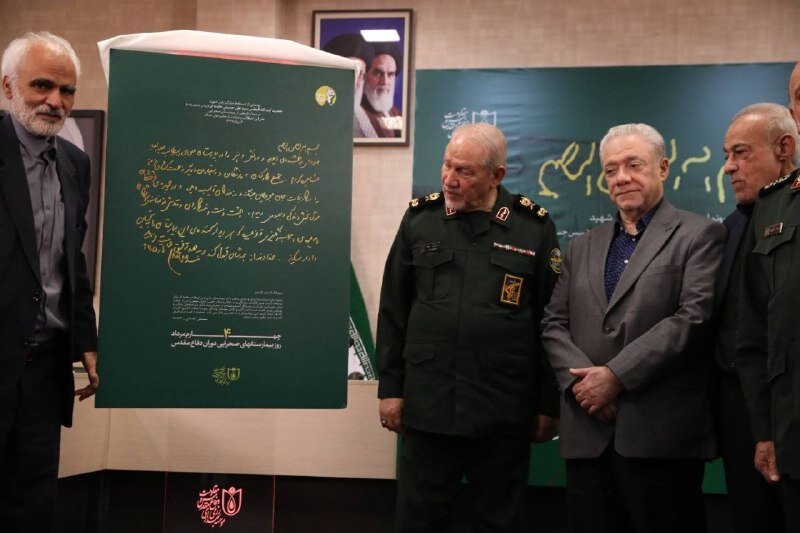
TEHRAN- A historic handwritten note by Iran's martyred Leader, Ayatollah Seyyed Ali Hosseini Khamenei, was unveiled on Sunday during a ceremony commemorating the role of field hospitals in the Sacred Defense.
The ceremony, held at the Emdadgaran Ashura Institute, marked the first public unveiling of the manuscript, which was written on July 26, 1988, during Ayatollah Khamenei's visit to the Hazrat Ali ibn Abi Talib (AS) Field Hospital.
At the time, Ayatollah Khamenei was serving as the President of the Islamic Republic of Iran. During his visit to the frontline medical facility, he met with soldiers wounded in the final days of the Iraqi-imposed war and penned a handwritten message that remained out of public view for decades.
In the note, he praised what he described as the "radiant manifestations of faith, knowledge and devotion" displayed by the hospital's physicians, medical staff and volunteers, commending their selfless efforts to save the lives of wounded soldiers. He wrote that their dedication had created "an astonishing achievement" that inspired admiration in every visitor.
"The sincere efforts of the physicians and medical staff have created an astonishing achievement that compels every visitor to admire them. May God accept their service and grant them success," the note reads.
Speaking at the ceremony, General Nasrollah Fat’hian, head of the Sacred Defense and Resistance Combat Medical Services Institute, recounted Ayatollah Seyyed Ali Khamenei's first visit to a frontline field hospital during the Iran-Iraq War.
Throughout the tour, Ayatollah Khamenei closely examined every section of the hospital—from the emergency ward and operating rooms to the laboratory, radiology unit, blood bank, and pharmacy—while speaking with wounded soldiers, physicians, nurses, and medical staff, he said.
Ayatollah Khamenei spent nearly 19 hours at this hospital and two more in the region, Fat’hian noted. He added that the handwritten note unveiled at the ceremony had been written at the end of that visit, but remained missing for decades until it was recently rediscovered during the production of a documentary on wartime combat medicine, paving the way for its public unveiling.
General Hassan Araqizadeh, deputy chief for health and medical affairs at the Armed Forces, recalled the formation of volunteer medical student units during the Sacred Defense. After receiving emergency training, the students were deployed to field hospitals and frontline aid stations during military operations. Araqizadeh said many of today's senior health officials began their careers as wartime volunteers, arguing that entrusting young people with responsibility remains essential for the future of the country's healthcare system.
He also praised the resilience of Iranian medical personnel in the years after the war, highlighting their service during natural disasters, the COVID-19 pandemic, and recent war, and noted that hospitals continued operating even under bombardment, with doctors and nurses remaining at their posts despite the risks.
For his part, Major General Yahya Rahim Safavi, a senior military advisor, reflected on Ayatollah Seyyed Ali Khamenei's role during the early years of the Iran-Iraq War, describing him as a decisive figure who championed the participation of volunteers alongside the regular army despite opposition from some senior officials at the time. Safavi recalled that Ayatollah Khamenei, then serving as the Imam Khomeini's representative to the Supreme Defense Council, insisted on visiting frontline positions in person, often wearing an unmarked military uniform and traveling to combat zones despite the risks.
Safavi also highlighted what he described as Ayatollah Khamenei's strategic judgment in several key wartime decisions, including efforts that helped break the siege of Susangerd and secure approval for the Abadan siege-breaking operation. He further credited a directive issued during Ayatollah Khamenei's presidency to reverse-engineer imported Scud missiles as an early step in the development of Iran's domestic missile industry, saying the decision laid the foundation for the country's subsequent missile capabilities.
SAB/
Leave a Comment